
If you have no idea what shouting music is or how it sounds, click on the link below to hear a sample: http://PlayAudio-234.com/play.asp?m=257323&f=KZHHYD&ps=7&p=1In fact, I'm going to be using the same concepts from GospelKeys 500 for the online classroom lesson below. The first concept to master is the left-hand bass run because it provides the foundation and rhythm for your shouting music. Concept #1: Left-hand bass runs There are tons of bass runs that can be used in shouting music. If you listen to the sample above, you'll hear a variety of different "runs." Some runs move downward (from high notes to low notes). Other bass runs (aka "bass lines") move in an ascending direction. MAJOR KEY: We'll be in the key of Ab major for this lesson. Let's learn a few ascending and descending bass runs. Ascending bass run (1-5): Ab C Db D Eb F Gb G Ab Note: These notes are played separately, one after the other (not together)! Tip: If you were to imitate the sound of a "shout" by stomping your feet and clapping your hands right after (that is: "stomp - clap - stomp - clap - stomp - clap"), your bass notes would be played on every beat, each time you stomp and clap). Descending bass run (1-5): Ab Gb F E Eb F Gb G Ab Notice that I called both of the examples above "1-5" bass runs. Why? Because they focus on the 1st and 5th keys of the scale. Let's look at the Ab major scale: Ab major: Ab Bb C Db Eb F G Ab If you were to place a number (starting at 1) by each of these notes, Ab would have a number "1" by it and Eb would have a number "5" by it. Since the bass runs above are both focused on Ab and Eb, they are called "1-5" bass runs. You can also "1-4" bass runs in shouting music. I'll give you a few below: Ascending bass run (1-4): Ab Bb B C Db F Gb G Ab Descending bass run (1-4): Ab Gb Eb D Db F Gb G Ab Congratulations. Now you have four bass runs to practice. In GospelKeys 500, you get many more to choose from. If you're really into this style of playing, I highly recommend it. So now that you have the left hand taken care of, I recommend that you practice it with a metronome. Metronomes are little $15 devices that keep rhythm for you at different speeds. You can choose the tempo so you can start off slow and build your speed as you get better. Also, if you have a keyboard with rhythmic and performing features, you can find "shouting rhythms" to accompany you while you practice these bass runs. The key is having some type of rhythmical device to keep your "timing" as you practice. Once you've mastered the left hand, there's many things to do on your right hand. Concept #2: Right-hand chordal movements While there are tons of things to do on your right hand, understanding how "13th" chords work is essential. A thirteenth chord is built on the (1), (3), (5), (b7), (9), (11), and (13) tones of a major scale. In C major, that would be: C + E + G + Bb + D + F + A (this time, played together). Now... Obviously, that's a lot of notes and most gospel musicians don't play thirteenth chords like that. An easier route is to play the C on your left hand and just play the Bb + D + F + A on your right hand. If you can reach, try adding in a high C and playing Bb + D + F + A + (C). C13 (abbreviated): C on left /// Bb D F A (C) on right. Now, let's bring that formula to Ab major. Ab13 = Ab on left /// Gb Bb Db F (Ab) on right. Putting it all together Playing an Ab13 in a rhythmic fashion over an Ab ascending or descending bass run is the foundation of shouting music. This combination, alone, can be played the entire time. The only thing is... ...Because shouting music is so repetitive (it's generally the same bass run over and over), you want to include other things (like variations in bass runs and different right-hand chordal movements and fill-ins) to spice things up. This is exactly the idea of GospelKeys 500 but I'll show a few concepts below. Three main parts of shouting music 1) The "Intro" 2) The "Main Loop" Period 3) The "Cool Down" Part One: The Intro The Intro is the start of the "shouting" period. You won't find full-length ascending and descending bass runs like I've posted above. Instead, you have teasers like: C -- Db --- D --- Eb. Usually the C and Db are played in pairs and the D and Eb are played in pairs. That's your left hand. As for your right hand, as shown in GospelKeys 500, you'll play something like: Bb Eb Ab (over the "C" bass from above) B Eb F Ab (over the "Db" bass from above) B D F Ab (over the "D" bass from above) C Eb Ab (over the "Eb" bass from above) This generally repeats for a good amount of time. The "Main Loop" period will usually follow right after. Part Two: The "Main Loop" Period You've already learned some things to do during the main loop period (concepts #1 and #2 from above). This is the moment of your shouting music when the bass run is fully active (unlike the 4-note bass runs used in the "intro"). You'll use full-powered ascending and descending bass runs along with right-hand chordal movements. For now, you've learned that the Ab13 chord can be played on your right while running the bass on your left hand. Other concepts that are covered in GospelKeys 500 are: - Diminished chord tricks - Right-hand fill-ins - More Fill-ins: b3 and b5 fill-ins - Three "magic" chords - Pentatonic and blues tricks - Chromatic drops and more... Part Three: The "Cool Down" The "Cool Down" period is just what it sounds like. It's the moment where the shouting music is coming to an end but instead of just abruptly ending, the cool down period allows you to play certain movements that are less active than the main loop period. More information... Other sections: "Beyond the Basics" Other concepts covered in GK 500 "Experiencing Shouting Music" 1) Role Reversal Techniques 2) Stride / Ragtime Effects 3) Linear Shouting Patterns / Vocal Accompaniment 4) Modulation More information... I hope you enjoyed this month's lesson and I'll be back soon! This concludes your Online Classroom Lesson If you were intrigued by the online classroom lesson above, then you would definitely benefit from my course! *** “The Secrets to Playing Piano By Ear” 300-pg Course ***
With 20 chapters and over 300 pages, the home piano course provides several resources, techniques, tips, principles, and theories to playing the piano by ear. Along with hundreds of chords and scales, you'll also learn how to turn them into gospel, jazz and blues chord progressions and better yet, how to use them to play ABSOLUTELY any song you want ... IN VIRTUALLY MINUTES! Again, don't miss this opportunity. I've even added an additional bonus if you purchase the course this week --- You can read more about the course at: http://www.homepianocourse.com
Please Let a friend know about HearandPlay.com! PLEASE FORWARD THIS ARTICLE TO YOUR ENTIRE E-MAIL ADDRESS BOOK.
Further References"The Secrets to Playing Piano By Ear" 300-pg Course [5] Chords & Progressions: pgs 65-78, 105-130, 147-165, 182-227.Do you know what a “2-5-1” or "3-6-2-5-1" progression is? Or perhaps the famous 12-bar blues chord progression? In this piano course, you will not only learn how to play gospel, blues, and jazz progressions, but how to recognize them in songs. In addition, you will learn the simple techniques to playing these progressions, hymns, and songs in all 12 major keys! ... Enjoy learning:
|

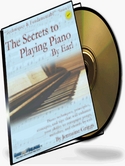 "The Secrets to Playing Piano By Ear" 300pg Course - Learn the secrets to playing literally any song on the piano with a few simple, "easy-to-understand" techniques and principles! Join Jermaine Griggs in learning tons of music theory, concepts, and tricks that will help you to learn piano by ear! Thousands of musicians have already taken advantage of this excellent program ... why not you? "The Secrets to Playing Piano By Ear" 300pg Course - Learn the secrets to playing literally any song on the piano with a few simple, "easy-to-understand" techniques and principles! Join Jermaine Griggs in learning tons of music theory, concepts, and tricks that will help you to learn piano by ear! Thousands of musicians have already taken advantage of this excellent program ... why not you? "The Secrets to Playing Piano By Ear" is full of easy-to-understand tricks, tips, techniques and secrets to playing piano by ear! For this month only, I've also been able to throw in a few bonus items (3 additional piano software programs). You won't regret it! |

No comments:
Post a Comment